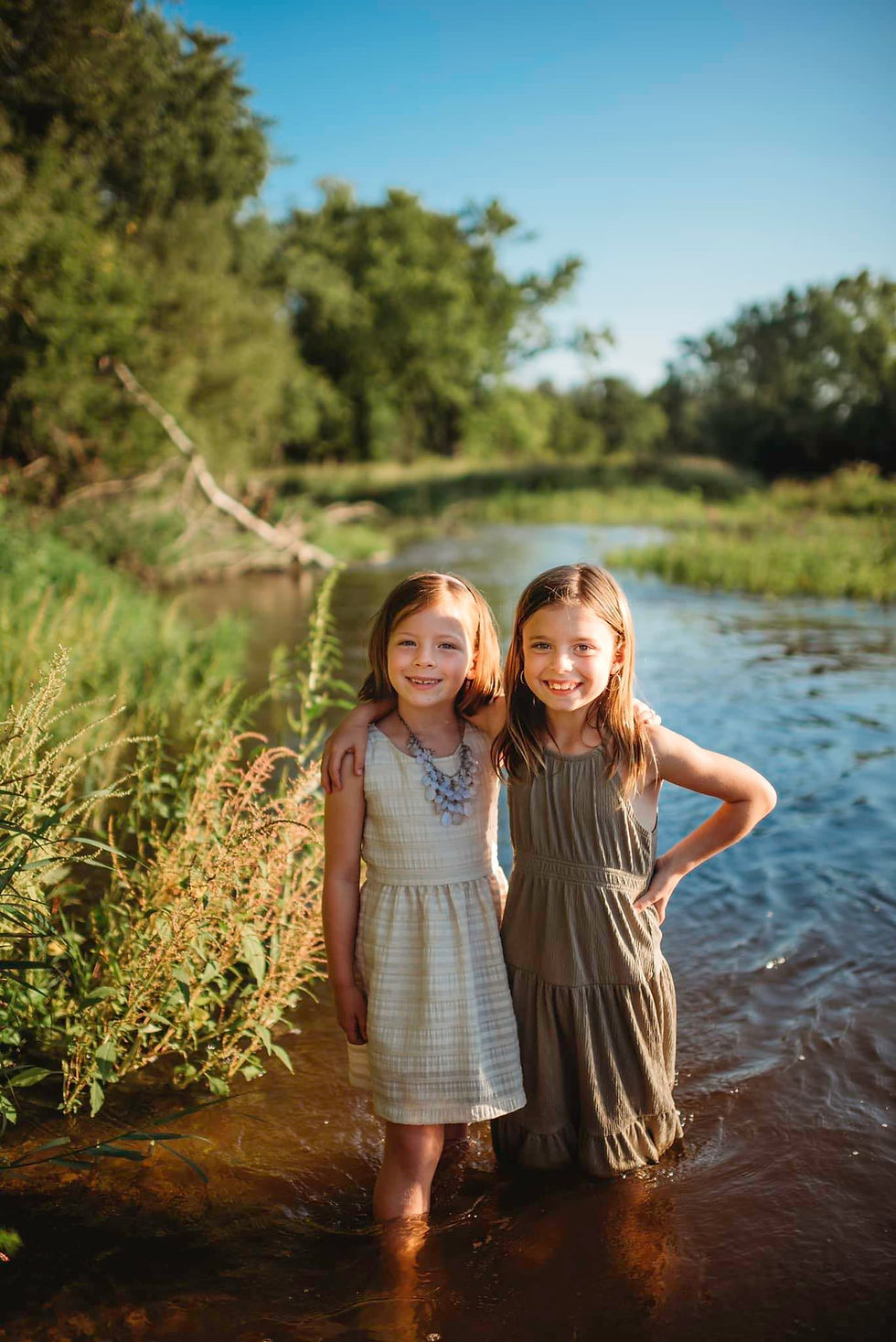
Charlie and Meili - The Knuth Family
- Jan 10
- 4 min read

Trisha Knuth’s life is a testament to the idea that "family" isn't just about who you are born to - it’s about who you fight for. Alongside her husband, Kevin, Trisha has navigated a journey marked by profound advocacy, medical breakthroughs, and a relentless commitment to children facing the unthinkable.
The Knuths’ path changed forever with their biological daughter, Chloe. Now 22, Chloe survived a traumatic shaken baby incident at just three months old while in daycare. Trisha immediately left her career to become Chloe’s full-time caregiver, a decision that set the stage for a lifetime of service.
While Chloe was in the hospital recovering, Trisha and Kevin learned that many medically-complex children were wards of the state after being abandoned at the hospital by their families. They decided to become foster parents to help. After a period of providing respite care for children - a role they eventually found too heartbreaking to continue - a single phone call from Children’s Wisconsin changed their lives again. It was Charlie.

In 2003, Charlie was born with Recessive Dystrophic Epidermolysis Bullosa (RDEB), a rare and devastating genetic condition that makes skin as fragile as a butterfly’s wing. Abandoned at two weeks old, Charlie was expected to pass away quickly. Trisha and Kevin took him in, intending only to provide peace and comfort for him in his final days. Instead, Trisha mastered the complex, agonizing world of EB wound care, and Charlie thrived. Both Trisha and Kevin decided to go all in, and adopt Charlie, as they knew they could give him the care he deserved.
When Charlie was five, a pioneering clinical trial (bone marrow transplant) in Minnesota offered hope, but Medicaid refused to cover it, due to it being experimental. Trisha refused to back down - she knew this was much needed, not only for Charlie, but everyone present and future who live with RDEB. In 2006, she took on the state, ignited a media firestorm, and gained the backing of influential politicians. She won. Her victory forced Wisconsin Medicaid to redefine "experimental" care, opening doors for rare disease patients across the state. Charlie’s impact went beyond policy, it reached the very blueprint of human life. He was the first child whose DNA was used to identify and successfully correct the RDEB gene mutation in a lab. This 2012 breakthrough, featured in Nature Magazine, became the foundation for every EB gene-editing clinical trial that exists today.
Though Charlie endured grueling recoveries and multiple transplants that allowed him to experience the simple joy of wearing shoes for the first time, Trisha explained how she saw Charlie's body healing while he was sedated, saying "his legs looked like little boy legs."
Charlie passed away peacefully in his sleep at the age of 17. His legacy lives on in every patient now receiving gene therapy.

Meanwhile, in 2015, a four-year-old girl named Meili waited in an orphanage in China, her tiny body encased in gauze. Born in 2011 with RDEB, her early years were defined by isolation and agony. Without parents to advocate for her, she endured the unimaginable: orphanage staff, unaware of the specialized care she required, would rip off her bandages, taking layers of her delicate skin with them. It took two years of tireless effort to bring her to the United States. By the time she arrived in 2017 at six years old, she finally had what every "Butterfly Child" needs - a family.

Today, Meili is 14 years old. Her mother, Trish, describes her as an "unbelievable girl," a testament to a spirit that refuses to be broken by a body that is constantly at war with itself. Now in the seventh grade, Meili navigates the halls of her school in a wheelchair, a necessary sanctuary to keep her safe from the friction of a crowded hallway. Supported by a personal aide, she attends not just for the academics, but for the social connection she was denied in her earliest years. She thrives on being part of the world, even as the world becomes harder to navigate.

Despite her courage, the reality of RDEB is relentless. Meili is currently facing a rapid and terrifying decline. The internal toll of the disease has become as severe as the external. She now requires frequent iron and blood transfusions just to sustain her strength. The scarring has caused her mouth to fuse at the corners, robbing her of the ability to smile - the very thing that expresses the joy she works so hard to find.
Meili's story is not just one of medical tragedy, but of a profound human will. She has transitioned from a child wrapped in rough gauze in a lonely orphanage to a teenager surrounded by love, fighting for every breath and every social interaction. While her body may be failing her, her impact on those around her remains profound.
The Knuth household is a landscape of contrasts, where the harrowing frontline of medical firsts meets the tender, chaotic joy of a growing family. While Meili continues her courageous fight, her journey is bolstered by the same fierce advocacy that defined Charlie’s legacy and Chloe’s survival. Even in the face of searing pain and unimaginable loss, the Knuths choose to expand their hearts rather than shield them. It is within this circle - built not just of blood, but of an ironclad commitment to one another - that we see the true definition of strength. A family that transforms personal tragedy into a universal blueprint for hope, proving that a "butterfly's wing" can indeed move mountains.